Auguste Escoffier’s 5 Mother Sauces of French Cooking
In classical French cuisine, few concepts are as enduring as the mother sauces. They are more than recipes. They are the technical foundation of countless preparations, the link between tradition and execution, and a defining element of refined gastronomy.
Popularized by Auguste Escoffier, the five mother sauces helped organize French culinary practice into a system that chefs could master, reproduce, and build upon. Escoffier is recognized as a major figure in culinary history and is noted for formalizing kitchen organization and shaping modern gastronomy.
For professional kitchens and serious cooks alike, these sauces remain essential. They teach precision, balance, texture, and flavour development. More importantly, they reveal why sauces continue to hold a central place in French cooking.
Why the Mother Sauces Still Matter
French cuisine has always treated sauce-making as a discipline in itself. A well-made sauce does more than accompany a dish. It brings structure, depth, and harmony to the plate.
That is exactly why the mother sauces remain so relevant today. Once mastered, they become a framework for creating a wide range of derivative sauces and finished dishes. This classical approach still matters in kitchens that value consistency, efficiency, and culinary authenticity. The same emphasis on traditional French gastronomy, concentrated flavour, and dependable performance is reflected in the broader culinary positioning of the site.
Who Was Auguste Escoffier?
Georges Auguste Escoffier (1846–1935) is one of the most influential chefs in the history of gastronomy. He helped codify French cuisine, streamlined kitchen organization, and brought greater clarity to classical culinary methods. On the site’s culinary heritage page, he is specifically described as the chef who formalized the kitchen brigade system.
His contribution to sauce-making was especially significant. By defining a core group of base sauces, he gave chefs a practical system from which many secondary sauces could be prepared. This transformed sauce-making from an overwhelming list of preparations into a disciplined culinary language.
What Are the 5 Mother Sauces?
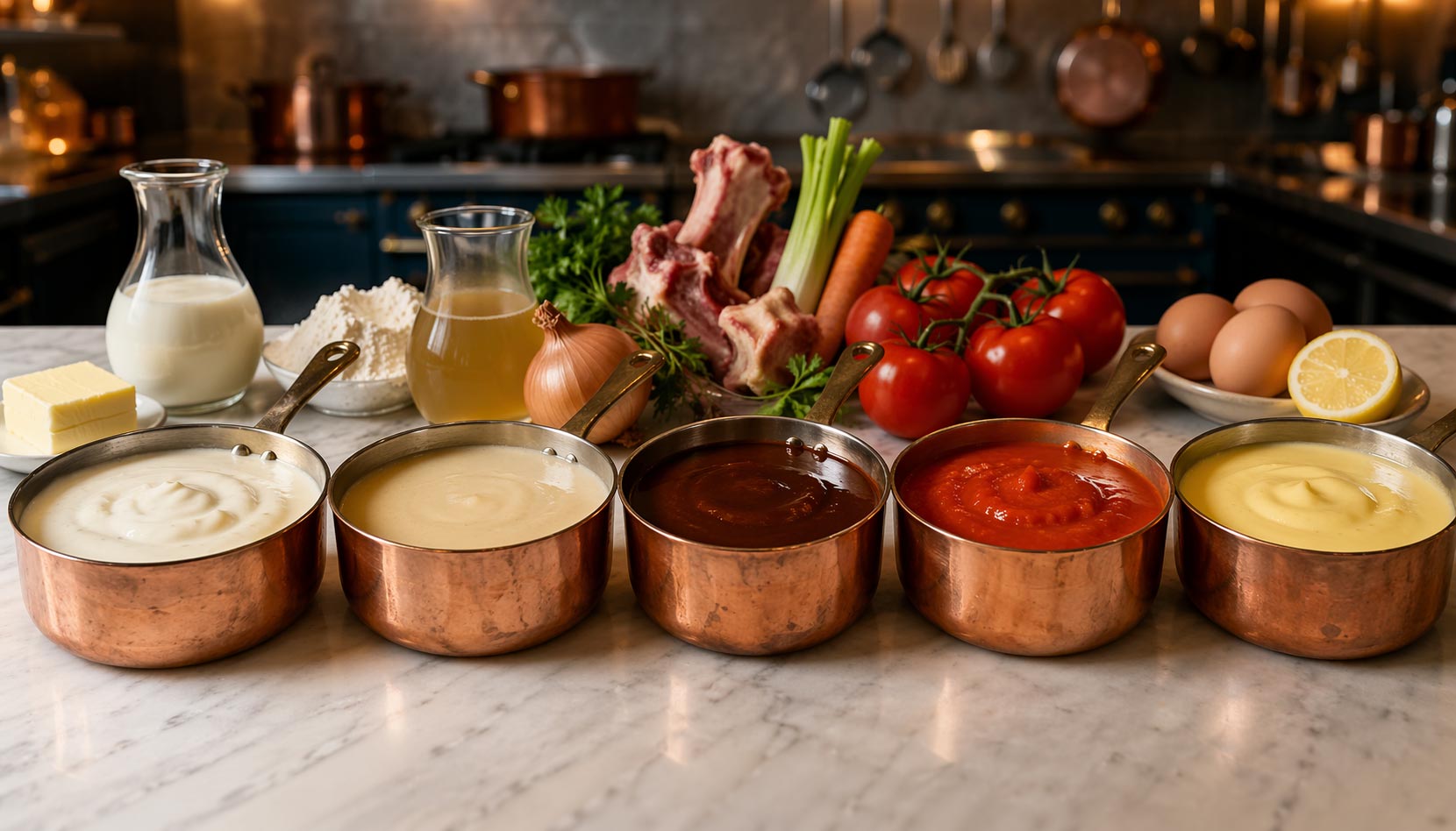
Escoffier’s five mother sauces are:
- Béchamel
- Velouté
- Espagnole
- Tomat
- Hollandaise
Each one serves as a starting point for a family of sauces and each brings a distinct role to the kitchen, from creaminess and delicacy to roasted depth and rich emulsion.
1. Béchamel: The Foundation of Creamy White Sauces
Béchamel is one of the simplest and most versatile of the mother sauces. It is traditionally made by combining a white roux with milk, resulting in a smooth, creamy sauce with a soft, rounded flavour.
Its strength lies in its adaptability. Béchamel can be seasoned lightly for subtle applications or enriched further for more indulgent dishes.
Where Béchamel Shines
Béchamel is often used in preparations where texture is just as important as flavour, such as:
- gratins
- lasagna
- baked pasta dishes
- croque monsieur
- vegetable casseroles
Classic Derivatives
From béchamel come several well-known daughter sauces, including:
- Mornay, enriched with cheese
- Soubise, classically paired with onion
- other cream-based variations used in baked and finished dishes
Béchamel reminds us that refinement in French cooking often begins with restraint. Its elegance comes from smooth texture, proper seasoning, and technical control.
2. Velouté: Delicate, Silky, and Exceptionally Versatile
Velouté is made with a light stock rather than milk. A blond roux is combined with chicken, veal, or fish stock, producing a sauce that is smooth, savoury, and more delicate than brown sauces.
Its texture is silky, while its flavour remains subtle enough to support rather than overpower the main ingredient.
Typical Uses for Velouté
Velouté works especially well with:
- poultry
- seafood
- white meats
- poached preparations
- delicate finished sauces
Classic Derivatives
Among the classic sauces derived from velouté are:
- Sauce Suprême
- Allemande
- various reductions and cream-finished sauces for poultry and fish
For chefs, velouté demonstrates the importance of a well-made stock. A sauce can only be as good as the aromatic base beneath it. That idea aligns closely with the site’s focus on broths, stocks, and concentrated flavour as building blocks of professional cuisine.
3. Espagnole: The Backbone of Brown Sauce Work
Espagnole, often referred to as brown sauce, is one of the most structured and complex mother sauces in the classical repertoire. It is traditionally made from brown stock, mirepoix, tomato, and a brown roux, then simmered to develop depth and balance.
This is where French sauce-making begins to show its full architectural power. Espagnole is not simply a sauce to serve on its own. It is the basis for richer, darker preparations that define much of classical meat cookery.
Why Espagnole Matters
Espagnole is central to:
- roasted meat dishes
- braised preparations
- reduction-based sauces
- classic brown sauce work
One of its most important descendants is demi-glace, a cornerstone of French gastronomy. On the site’s product page, demi-glace is explicitly described as holding a central place in French gastronomy and as an ideal base for classic French sauces.
That connection makes Espagnole especially important in any discussion of French culinary foundations. It is the mother sauce that leads directly into some of the most concentrated, richly layered flavour profiles in classical cuisine.
4. Tomat: French Tomato Sauce with Classical Depth
The French mother sauce Tomat differs from the quick tomato sauces many cooks know today. In the classical tradition, it is a more developed preparation, often built with tomatoes, aromatics, and additional savoury elements, then cooked slowly to achieve body and balance.
This longer process creates a sauce that is both vibrant and rounded, with acidity carefully integrated into a deeper flavour structure.
Best Uses for Tomat
Tomat can be used in:
- braised dishes
- stuffed vegetable preparations
- pasta applications
- finished meat dishes
- traditional French recipes requiring tomato depth without harsh acidity
Among the five mother sauces, Tomat is perhaps the most familiar to modern cooks, yet classical technique reveals how much more nuanced it can become when treated with patience and discipline.
5. Hollandaise: Precision, Emulsion, and Richness
Hollandaise stands apart from the other mother sauces because it is not thickened with roux. Instead, it is an emulsified sauce made from egg yolks and butter, balanced with acidity.
When executed properly, hollandaise is smooth, warm, glossy, and light despite its richness. When handled poorly, it breaks. That is why it is so often seen as a test of technical confidence.
Classic Pairings for Hollandaise
Hollandaise is traditionally served with:
- asparagus
- poached fish
- eggs Benedict
- tender vegetables
Classic Derivatives
Its best-known derivatives include:
- Béarnaise
- Mousseline
- citrus-based variations
Hollandaise proves that French sauce-making is not only about long reductions and stocks. It is also about finesse, control, and timing.
The Real Lesson Behind the Mother Sauces
What makes the mother sauces so enduring is not just tradition. It is usefulness.
They teach cooks how to think in structure:
- how to build flavour from a proper base
- how to control consistency
- how to match sauce intensity to the main ingredient
- how to create variety from a single classical preparation
In professional kitchens, this matters every day. A concentrated stock, a proper reduction, or a balanced sauce can transform service by improving both consistency and execution. The site repeatedly emphasizes these same values: traditional craftsmanship, industrial reliability, authentic flavour, and products designed to support chefs in demanding kitchen environments.
A Lasting Legacy in French Gastronomy
Escoffier’s system continues to shape culinary education and professional practice because it offers both heritage and utility. The mother sauces are a living part of French gastronomy, connecting generations of chefs through shared technique and standards.
They remain relevant not because they are old, but because they still work.
For anyone interested in the foundations of classical cuisine, learning the five mother sauces is one of the clearest ways to understand how French cooking achieves elegance, depth, and precision.
Final Thoughts
Auguste Escoffier’s 5 mother sauces of French cooking remain one of the greatest organizing principles in gastronomy. From the soft richness of béchamel to the roasted depth of espagnole and the refined emulsion of hollandaise, each sauce represents a different dimension of culinary technique.
Together, they form the backbone of classical French sauce-making and continue to inspire chefs who value authenticity, structure, and flavour.
In the end, the mother sauces are not just part of culinary history. They are still the foundation of great cooking.